Good Morning Bitcoin, 16 November
Today's Snapshot
- White House fills SEC and CFTC seats
- Vault rewrite closes audit gaps
- ETF outflows hit nine of ten days
Bitcoin's price isn't the story this morning, but the flows behind it are: US spot ETFs have bled for nine of the last ten sessions. Elsewhere, the White House has named four new financial regulators, and a BSV wallet has strengthened its Vault after an audit. Let's get into it:
White House sends four SEC and CFTC nominees to the Senate
The news
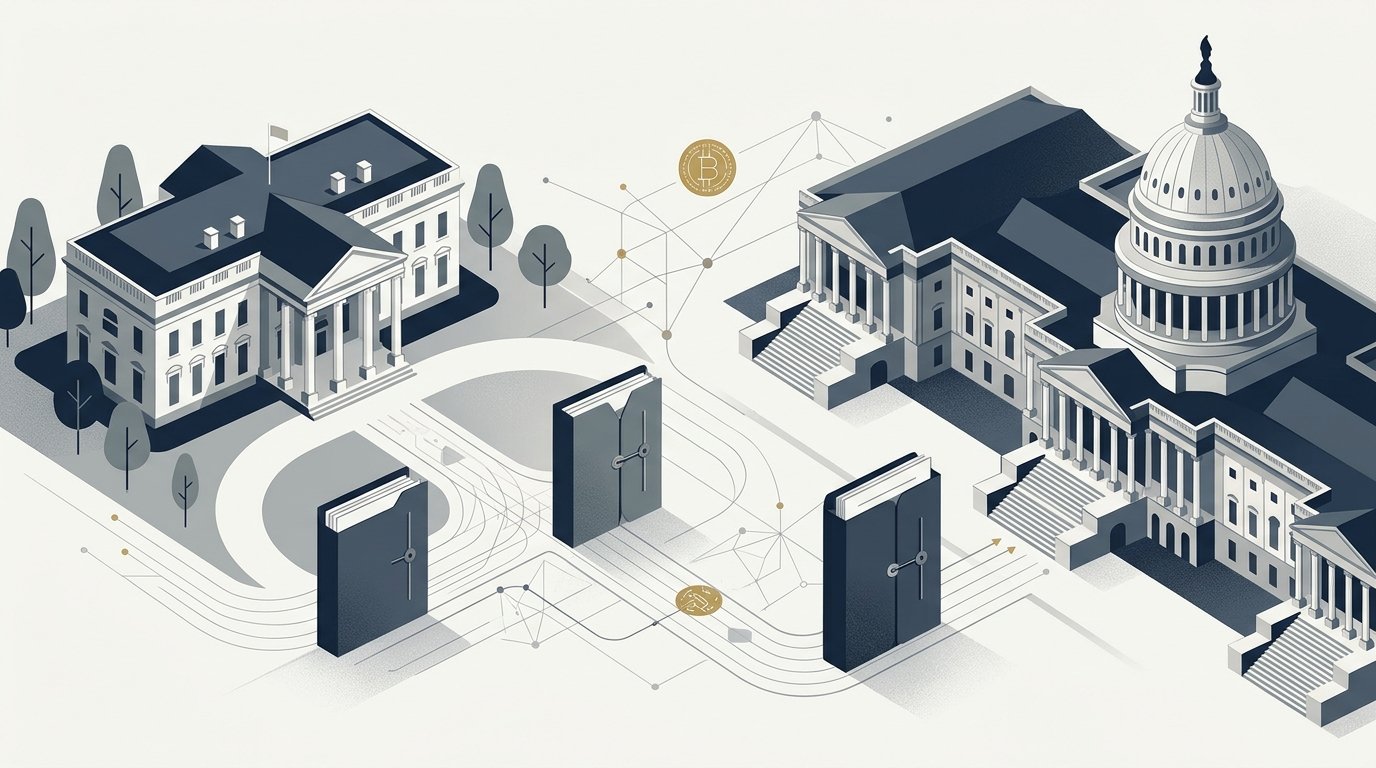
The White House sent four nominations to the Senate on 12 November 2026, the first SEC and CFTC nominations in roughly a year. They fill seats left vacant by commissioners who have departed. Kristin N. Johnson and Steven Levine are named for the SEC, while Nathan Anonick and Matthew Rowland are named for the CFTC.
The White House's nomination notice lays out the terms. Johnson, of Michigan, takes a term expiring 5 June 2029, replacing Caroline A. Crenshaw. Levine, of Maryland, takes a term expiring 5 June 2030, replacing Hester Maria Peirce.
At the CFTC, Anonick, of Virginia, is nominated to a term expiring 19 June 2031, replacing Rostin Behnam. Rowland, of the District of Columbia, is nominated to the remainder of a term expiring 13 April 2028, replacing Summer K. Mersinger.
The slate is bipartisan: Johnson and Rowland are Democrats, Anonick and Levine are Republicans. Until now, the CFTC has operated with Chairman Michael Selig as its sole commissioner. The SEC has had only Chair Paul Atkins and Commissioner Mark Uyeda, both Republicans.
What's next?
Senate confirmation is the next step. Watch for committee hearings and votes on each nominee.
The Takeaway
The Takeaway: Rules for digital assets will soon be voted on by full commissions, and BSV builders need to read them as they land
Congress hasn't passed new market-structure legislation, so both agencies are writing crypto rules under existing authority. With one commissioner at the CFTC and two at the SEC, those rules have had very few hands on them. Four new seats change who gets to vote.
For BSV, the practical point is the CFTC term ending 13 April 2028 and the SEC terms running to 2029 and 2030. Those dates set the horizon over which the rulebook is likely to take shape. Businesses building data and payment services on BSV can plan against that window rather than a moving target.
A two-two party split also suggests rules written with cross-party votes behind them. Those tend to last longer than rules passed by one side.
BSV wallet rewrites Vault recovery after a pre-launch audit
The news
The bsv-wallet project merged pull request #104 on 14 November 2026, a set of Vault fixes responding to findings from a pre-launch security audit. The changes ship in wallet-toolbox version 0.25.0. They enforce two rules: the mnemonic plus any one registered YubiKey always recovers funds, and nobody without both can.
According to the pull request, a chain lookup that could previously return an ambiguous result now returns one of three states: found, none or unknown. An unknown result fails closed. It's never read as "no funds" and never permits certain recovery actions.
Adding a key now requires staging it first. Only a re-lock signed by an existing key, or an existing key's tap on an empty vault, activates the new key. A full withdrawal is never gated behind an added key.
The merge also adds a minimum scan floor of 100,000 satoshis so dust transactions can't shadow or wedge a real deposit. A PIV reset or occupied-slot key enrollment now needs a completed chain check or an explicit acknowledgement of potential funds loss.
The author's notes record a full run of 450 suites and 7,781 tests, all passing. They also flag that physical YubiKey hardware wasn't available, so that path wasn't tested.
What's next?
Hardware testing with a physical YubiKey is the open item to watch before the Vault is treated as proven.
The Takeaway
The Takeaway: The three-state lookup shows how a wallet should treat doubt: as a reason to stop, not to guess
The most useful detail is the unknown state. A wallet that reads a failed lookup as "empty" can prompt actions that destroy real funds. Making unknown its own outcome removes that failure mode.
The 100,000 satoshi floor addresses something specific to a chain with cheap, plentiful transactions: anyone can send dust to clutter a scan. A defence that ignores dust below a threshold keeps a real deposit visible.
The untested hardware path is a fair caveat. Holders should wait for that coverage before putting large sums behind a YubiKey flow.
US spot Bitcoin ETFs post nine outflow days in ten sessions
The news
US spot Bitcoin ETFs recorded a combined net outflow of roughly $2,347.0 million over the ten trading days from 2 to 13 November 2026. Nine of the ten sessions were net outflows. Only 4 November was positive, at +$74.6 million.
Farside Investors' published daily flow table shows -$284.1 million on 12 November and -$185.4 million on 13 November. BlackRock's IBIT led the selling on nearly every negative day, with -$203.8 million on 12 November and -$143.5 million on 13 November.
Fidelity's FBTC also posted outflows on both days, -$32.6 million and -$41.9 million. That reversed its earlier inflow days in the same run.
Cumulative net inflows since the January 2024 launch stood at $54,701 million as of 13 November, down from roughly $55.8 billion before the run began.
What's next?
The next daily flow tables will show whether FBTC's reversal holds or selling narrows.
The Takeaway
The Takeaway: Redemptions across more than one issuer measure appetite for a price product, not use of the network
The detail that matters is FBTC. It had been taking in money earlier in the run and has now joined IBIT in outflows. Selling is spreading across issuers.
Roughly $1.1 billion has left a cumulative total of about $54.7 billion. That's a small share, which keeps the episode in proportion.
None of this touches how Bitcoin is used. An ETF holder owns a claim on price, with no ability to send data or payments. BSV's case rests on transactions that happen on-chain, and those don't depend on fund flows.
What to Watch
- Senate hearings - Confirmation hearings for the four nominees, expected after the 12 November transmission, will show who shapes US crypto rules and how BSV businesses should plan.
- Vault hardware tests - Physical YubiKey testing after the 14 November merge of wallet-toolbox 0.25.0 would close the one gap the author flagged, which matters for BSV self-custody.
- ETF flow tables - Daily figures from 16 November onward will show whether the outflow run extends, offering context for BSV on sentiment toward Bitcoin.
Four seats filled, one wallet hardened and a market still heading for the exit: the people who set the rules are finally arriving.