Good Morning Bitcoin, 16 September
Today's Snapshot
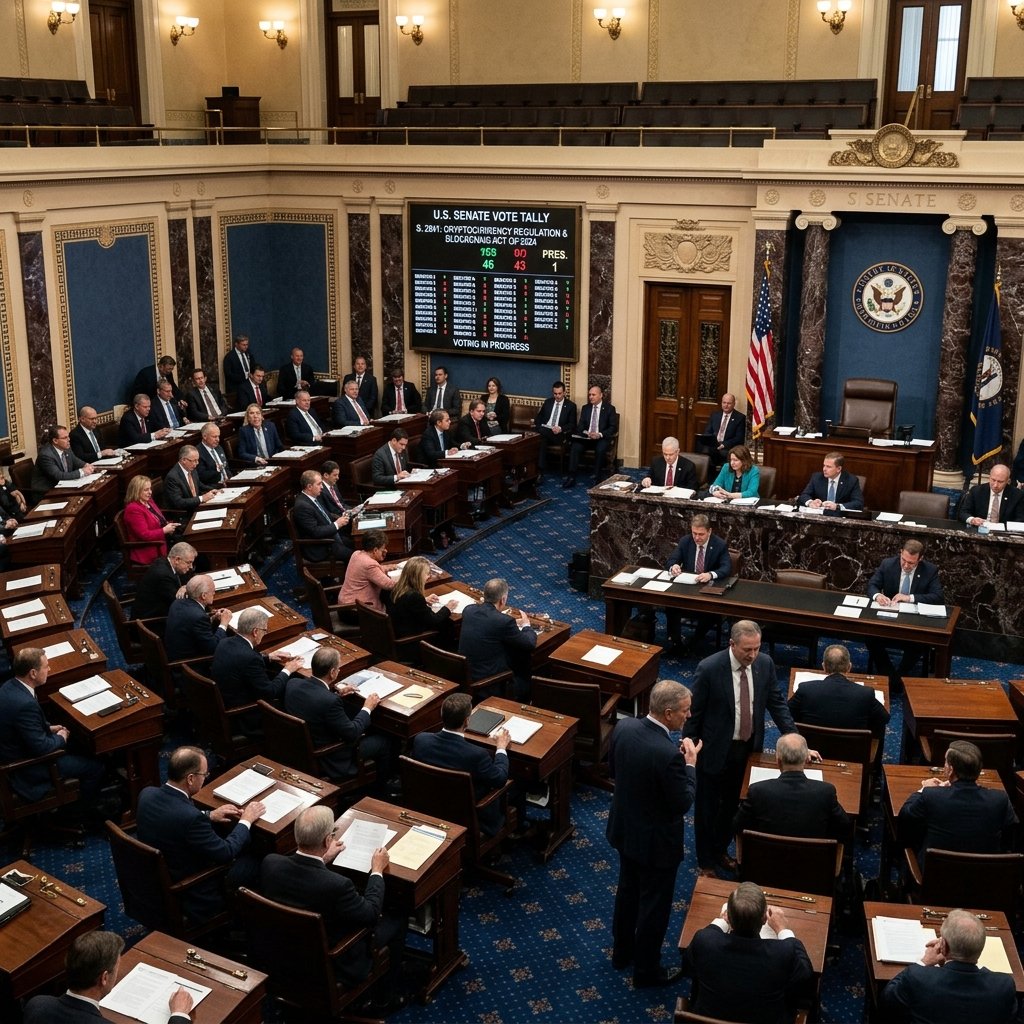
- Senate kills CLARITY Act in 46-43 cloture vote
- Votari brings verifiable elections to BSV mainnet
- Bitcoin reserve bill advances to House committee
The Senate killed the CLARITY Act yesterday in a 46-43 cloture vote, falling short of the 60 votes required. The bill now appears finished, at least for 2026. Meanwhile, Votari quietly launched on iOS and Android with the first fully auditable on-chain election platform built on BSV. Congress's strategic Bitcoin reserve bill also cleared another hurdle and headed to committee markup on the same morning that the broader crypto framework collapsed. Let's get into it:
Senate Kills the CLARITY Act
The news
The US Senate voted 46-43 on September 15 to advance the Digital Asset Market Clarity Act to the floor, falling 14 votes short of the 60 needed for cloture. Senator Cynthia Lummis said negotiations were finished, arguing that Republicans had offered "over 120 concessions" to Democrats who still voted no. The bill is effectively dead for 2026.
The CLARITY Act would have classified every crypto token as a security, digital commodity or stablecoin, assigning oversight to the SEC or CFTC. It collapsed over three unresolved disputes: ethics rules targeting President Trump's $1.4 billion in personal crypto income, DeFi developer liability under Section 604 and a stablecoin yield provision that threatened $1.35 billion in annual Coinbase USDC rewards revenue.
Key Democratic negotiators, Senators Gillibrand, Warner, Booker and Warnock, voted against the bill despite months of bipartisan talks.
Crypto markets responded immediately. Bitcoin slid from near $80,000 before the vote. Industry lawyers say the SEC's proposed Regulation Crypto Assets, released in August, now becomes the de facto fallback framework for digital assets until at least the next Congress in 2027.
What's next?
With the legislative window closed, expect more SEC enforcement under the Regulation Crypto Assets fallback. Crypto companies face at least a 2027 wait for any market structure clarity from Congress.
The Takeaway
BSV was never waiting for this bill, and its always-compliant protocol just became its biggest competitive advantage.
While BTC-focused lobbying groups spent years and hundreds of millions of dollars trying to secure special treatment under existing securities law, BSV developers locked the protocol in place and built within existing legal frameworks from the start. The CLARITY Act's collapse makes that posture look prescient.
BSV's unbounded-scale data and payments network doesn't need a new regulatory category. It operates as what Bitcoin was designed to be: a commodity-like public record system where miners process data for fees. When Congress can't deliver clarity, the chain that already has it wins. Enterprise builders looking for a stable compliance surface now have one fewer reason to wait on BTC.
Votari Goes Live: Verifiable Elections on BSV
The news
Votari, a mobile application for verifiable on-chain elections and surveys, launched its full release on iOS and Android on September 15. Built on BSV, the platform records anonymized and independently auditable ballot results directly to the blockchain. No private Votari database holds the underlying data.
Developer Rui da Silva designed Votari around three eligibility models: open voting with no verification required, email-domain verification for organisation-specific polls and passport verification using local facial recognition. Voters construct ballots non-custodially on their devices before broadcasting them.
Records stored on BSV remain permanently auditable by any party without requiring trust in Votari as an intermediary.
The platform targets companies, boards, professional bodies, universities and membership organisations rather than national government elections. A trial period running since January 2026 tested basic community polls before the full feature set shipped today.
What's next?
Votari is talking with organisations about formal deployment. The next development phase targets more complex eligibility models and multi-round election formats.
The Takeaway
Tamper-proof records at BSV scale turn the "trust the process" problem into a verifiable fact.
Every election system faces the same legitimacy question: how do you prove the count wasn't manipulated? Votari's answer is to move the record to a chain that no single party controls.
BSV provides a public blockchain designed to store this kind of high-volume, low-cost data at scale. Its sub-cent fee structure makes per-vote on-chain writes economically viable. The Votari model, anonymized ballot, auditable chain record and no custodian, offers a template for institutional decision-making that needs a verifiable process without trusted intermediaries. This is a concrete BSV use case that didn't exist six months ago.
Bitcoin Reserve Bill Heads to House Committee
The news
The US House Financial Services Committee holds a markup session on September 16 for H.R. 8957, the American Reserve Modernization Act of 2026. The bipartisan bill, sponsored by Rep. Nick Begich with co-lead Rep. Jared Golden, would write a strategic Bitcoin reserve into federal statute with a mandatory 20-year holding period.
Key provisions include a ban on Treasury selling or encumbering its Bitcoin for 20 years, quarterly proof-of-reserve reports audited by independent third parties and a separate digital asset stockpile for non-Bitcoin holdings. Proceeds would go toward additional Bitcoin purchases or debt reduction.
The bill would formalise the Bitcoin reserve President Trump established by executive order and place it under congressional oversight and Government Accountability Office review. It has 23 bipartisan cosponsors.
The committee markup is an early legislative step. Approval would send the bill toward a full House floor vote, not immediate enactment.
What's next?
Committee approval in September could set up a full House vote before the year-end floor shutdown. A Senate companion bill would still need to be written and advanced separately.
The Takeaway
Government validation of Bitcoin as a reserve asset raises the stakes for defining which chain that actually means.
H.R. 8957 refers exclusively to "Bitcoin" as a government reserve asset. Every institution that buys into that thesis is implicitly endorsing the chain that best embodies the original Bitcoin design: fixed supply, immutable ledger and public verification.
BSV's case has always been that it IS the original Bitcoin, the one with Satoshi's protocol intact and the capacity to scale for the data and payment volume a reserve-grade network requires. As governments formalise Bitcoin's status in statute, the question of which chain honours that design becomes harder to ignore.
What to Watch
- Philippines tightens VASP rules and launches a $34.4 billion AI initiative - The Bangko Sentral ng Pilipinas tightened virtual asset service provider licensing on September 15, as the country unveiled a $34.4 billion AI push to drive digital trade infrastructure across ASEAN. High-volume data pipelines at national scale are exactly where BSV's throughput advantage matters most.
- Japan's CBDC pilot hits 50,000 TPS but the digital yen remains distant - The Bank of Japan's digital currency tests reached 50,000 transactions per second in its latest pilot, but the central bank still hasn't decided whether to issue it fully. Every CBDC system tested on permissioned rails supports the view that high-throughput digital money needs serious engineering, which is the bar BSV's unbounded-scale design was built to clear.
Until tomorrow. Stay original.