Good Morning Bitcoin, 7 October
Today's Snapshot
- CFTC Opens Crypto Rulebook
- Tokenization Hits Production Scale
- Bitcoin Rejected at $87,000 Again
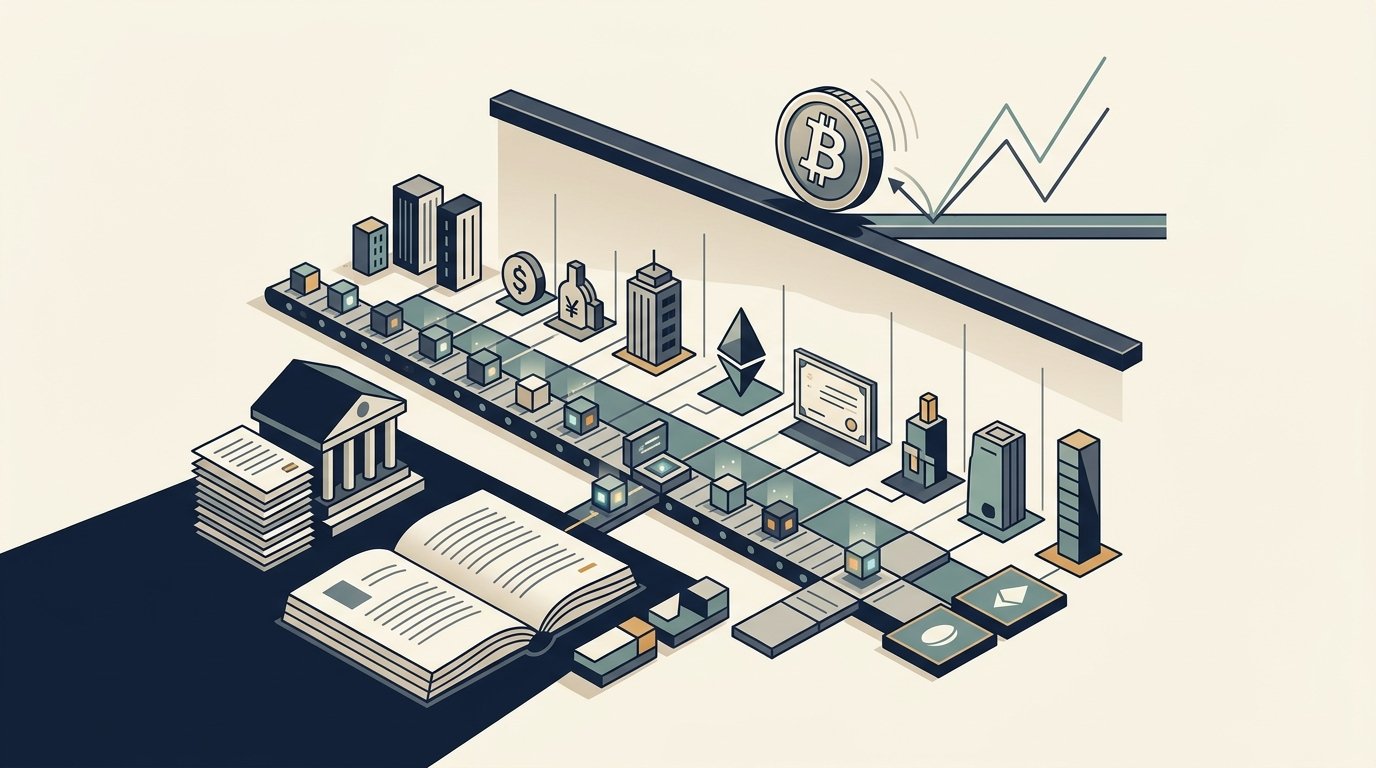
The CFTC has put a federal registration framework for leveraged crypto trading out for public comment, institutions are moving trillions through tokenized rails in daily production, and Bitcoin keeps bouncing off $87,000 for a third time since late September. All three stories point in the same direction: the market wants rails built to run, not pilots that need policing. Let's get into it:
CFTC Opens Crypto Rulebook With Leveraged Trading ANPRM
The news
On 5 October 2026, the Commodity Futures Trading Commission published an Advance Notice of Proposed Rulemaking, "Regulation Crypto Asset Transactions and Regulation Crypto Asset Markets" (Release No. 9307-26, RIN 3038-AF80), seeking comment on how retail leveraged crypto transactions should be regulated under the Commodity Exchange Act.
The ANPRM outlines two connected frameworks, according to the CFTC's release: Regulation CTX, defining retail crypto transactions involving leverage, margin or financing and Regulation CAM, a new federal registration category for platforms offering them. Market participants have 60 days from Federal Register publication to comment.
The move follows the stall of the CLARITY Act in Congress. Investing.com and others see it as the CFTC building a federal framework through rulemaking rather than waiting on legislators. On 6 October, Bitcoin twice topped $86,000, reaching an intraday peak of $86,450 in trading that CoinDesk tied directly to the news.
What's next?
The comment window runs 60 days from 5 October 2026, closing in early December, before any proposed rule follows.
The Takeaway
The Takeaway: Federal registration by definition, not enforcement, is the regulatory shape BSV was built to fit
A framework built on clear definitions, a registration category and a comment period is a sharp contrast with the ad hoc enforcement era that shaped much of crypto's last decade. It rewards platforms that can show their rails in daily operation instead of retrofitting compliance after the fact.
BSV's compliance-by-design approach, with data recorded on an immutable, auditable ledger, is built for exactly this kind of scrutiny. Where other chains treat regulation as an external threat to route around, BSV treats it as an input to the protocol's design.
The market's immediate price reaction shows that regulatory clarity is seen as a bullish signal across crypto. For BSV, the more durable signal is structural: a federal registration regime for trading platforms favours ledgers that were already built to be inspected.
Tokenization Moves From Issuance Trials to Daily Production Use
The news
CoinGeek's 6 October 2026 analysis argues that tokenization has moved from "phase one", issuance and experimentation, into "phase two", utility, stating plainly that "it is real, live and in production today."
The Depository Trust and Clearing Corporation, which custodies more than $114 trillion in assets, converted DTC-held securities into tokens for production transactions in July 2026. The Eurosystem's Pontes platform launched in September 2026, settling wholesale tokenized-asset transactions directly in central bank money.
JPMorgan's Kinexys platform has processed more than $3 trillion since inception and now averages $7 billion in daily transactions, per CoinGeek. Real-world-asset deposits on lending platforms rose to $7.4 billion between Q2 2025 and Q2 2026, while RWA spot trading volume rose roughly 220% over the same period.
What's next?
Pontes, live since September 2026, is expected to add more wholesale settlement volume through the rest of Q4 2026.
The Takeaway
The Takeaway: The institutions moving the most value are proving BSV's original use case at production scale
DTCC converting $114 trillion in custody into token-based production transactions and JPMorgan averaging $7 billion a day on Kinexys aren't pilots. They're the use case BSV was designed for from the outset: ledger-recorded assets moving at volume, with every transaction accounted for.
This is where an unbounded block size matters. A ledger that can scale its throughput without artificial limits is the only kind of infrastructure that can absorb daily volumes in the billions without congestion or fee spikes. That's precisely the condition these institutions now operate under elsewhere.
The RWA figures, with spot trading volume up 220% and deposits reaching $7.4 billion, show that this shift is accelerating, not stalling. BSV's case was never that tokenization would arrive. It was that when it did, it would need infrastructure built for enterprise data and payments from day one, not bolted on later.
Bitcoin Rejected at $87,000 for a Third Time Since Late September
The news
Bitcoin traded at $86,281.11 at 7:30 a.m. Eastern Time on 6 October 2026, per Fortune's daily tracker. Sellers had turned back a rally from just above $87,000 on 5 October, the third rejection at that level since 23 September 2026, according to CoinDesk.
Bitcoin twice topped $86,000 on 6 October following the CFTC news, reaching an intraday peak of $86,450 before pulling back to around $85,500 by 1:15 p.m. EST, putting its market capitalisation near $1.72 trillion. Six days earlier, it had entered October trading at roughly $83,700.
On-chain analyst Ali Martinez noted that 1.59 million BTC changed hands between $83,300 and $84,600, calling it major support. Bitfinex analysts forecast a near-term range of $84,000 to $87,722 ahead of US CPI data, which traders see as the next likely catalyst.
What's next?
A sustained break above $87,000 to $87,500 would open a path toward $90,000, last seen roughly eight months ago. Another rejection would shift attention back to support around $84,000 to $85,000.
The Takeaway
The Takeaway: A market this fixated on one resistance line is trading speculation, not settlement volume
Three rejections at the same level since 23 September, with traders waiting on a single CPI release to decide direction, describe a market driven by leveraged positioning rather than everyday use. The $1.72 trillion market capitalisation sits on top of that speculative churn, not beneath a growing base of daily transactions.
That's the structural gap between BTC's price action and BSV's purpose. BSV isn't built to be a resistance-level trade. It's built so a fixed block cap never forces fees up during periods of congestion and enterprise users can plan around predictable low fees rather than a chart waiting on a data print.
The CFTC story and this one share a root cause: a market still organised around leverage and narrow bands of liquidity needs registration clarity and ledger stability to reduce that fragility, not add to it.
What to Watch
- CPI release - US CPI inflation data, expected in mid October 2026, is seen by Bitfinex analysts as the likely catalyst to break Bitcoin's $84,000 to $87,722 range. It's a reminder that BTC's price still hinges on macro data rather than settled transaction volume.
- CFTC comment window - The ANPRM comment period runs for 60 days from 5 October 2026, closing in early December. This is the window in which the shape of federal registration for crypto platforms gets decided.
- Liquidation anniversary - 10 October 2026 marks one year since the 10 October 2025 event that wiped out more than $19 billion in leveraged positions, a standing argument for ledgers built around settlement rather than leverage.
- Pontes expansion - The Eurosystem's Pontes platform, live since September 2026, is expected to add further wholesale settlement volume through Q4 2026. More proof that tokenized settlement at scale is now routine infrastructure.
Until tomorrow, the ledger keeps running at whatever scale the work demands.