Good Morning Bitcoin, 28 September
Today's Snapshot
- Bitcoin slips as oil tops $100
- Sibos 2026 opens with tokenization at the centre
- Bitget details how attackers tested its defenses before $388 million theft
A rejected Iran ceasefire plan sent oil past $100 and Bitcoin lower. Swift's Sibos conference opened in Miami with bank chiefs declaring cash dethroned, while Bitget's CEO walked through how attackers probed the exchange's defenses before draining $388 million. Three stories, one thread: settlement infrastructure is being stress-tested from every direction. Let's get into it:
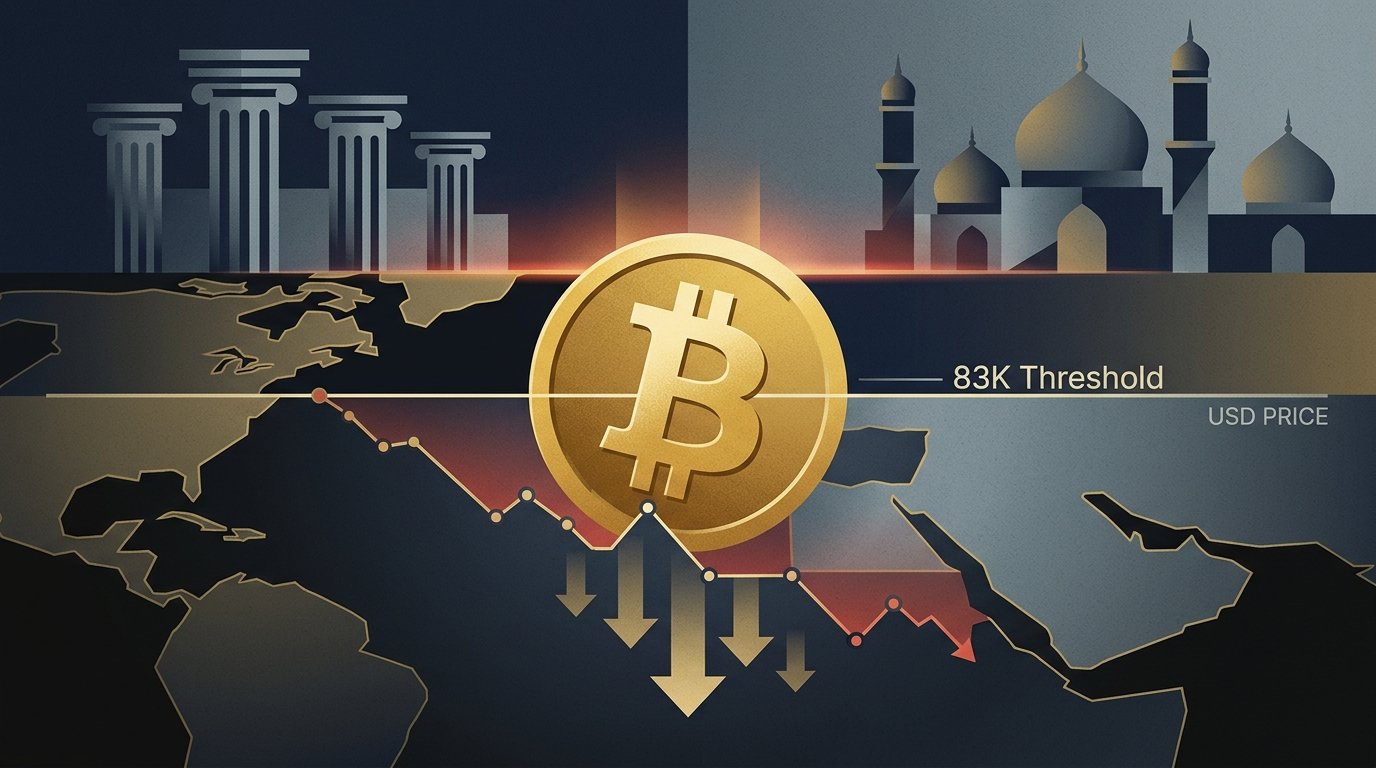
Bitcoin slips below $83,000 as Trump rejects Iran's ceasefire plan
The news
Bitcoin opened at $84,457.30 on 28 September 2026, nearly flat from Sunday, then fell to $82,957.64 by 7:20am ET. It traded around $83,068.75 by 11:35am ET, a decline of about $1,345 from the prior session, after President Trump rejected Iran's seven-day ceasefire plan.
The rejection of Iran's plan to end hostilities and reopen the Strait of Hormuz sent Brent crude above $100 a barrel as pessimism about peace grew, according to market reporting on the session. A strong dollar, higher bond yields and rising oil combined to dull demand for non-yielding assets, including Bitcoin and precious metals.
Expectations for a Federal Reserve rate rise next month climbed alongside the oil-price jump, adding further pressure. Ethereum fell in step, from $2,687.59 to $2,662.70, down 0.3% on the day. Bitcoin's market cap stood near $1.33 trillion, versus Ethereum's roughly $233 billion.
Despite the daily fall, Bitcoin remained up about 4.1% week-over-week and 5.2% month-over-week, though down roughly 23% year-over-year.
What's next?
Fed rate-decision signals and any movement on the Iran ceasefire plan are the near-term drivers to watch. Either could bring a repeat of this session's pattern.
The Takeaway
The Takeaway: Bitcoin's price still trades on macro fear, BSV's case rests on utility, not sentiment
A ceasefire rejection in Iran pushed oil past $100 and dragged Bitcoin down that same morning. It confirms what BSV has argued for years: BTC behaves as a macro risk asset, not a settlement network insulated from geopolitics. Its price swings on Fed expectations and dollar strength, the same forces that move equities and oil futures.
BSV's design intentionally separates the network's utility, unbounded on chain data and payments capacity, from short term price speculation. An enterprise processing invoices or supply chain records on BSV rail isn't exposed to whether Trump accepts a ceasefire plan; the fee to timestamp a record stays predictable regardless of what oil does.
That distinction matters for anyone building infrastructure rather than trading it. Price volatility driven by geopolitical headlines is a trading concern. Protocol stability and low, predictable fees are an infrastructure concern, and BSV was built to answer the second question, not the first.
Sibos 2026 opens in Miami with tokenized money and AI dominating the agenda
The news
Sibos 2026, Swift's flagship conference, opened on 28 September 2026 at the Miami Beach Convention Center and runs through 1 October. It has drawn more than 12,000 professionals across over 250 sessions under the theme "Digital Finance for AI-Driven Economies."
Citi Chair and CEO Jane Fraser delivered the opening plenary at 11:00 alongside Swift CEO Javier Pérez-Tasso and Swift Chair Graeme Munro, covering trade finance, resilience, interoperability and AI. Fraser said "cash has been dethroned," pointing to the transparency, safety and access benefits of digital payment rails over physical cash.
Sibos coverage framed 2026 as the year tokenization moved fully out of the sandbox, with dedicated sessions on tokenised corporate actions, the digital asset landscape and custody in a tokenised world. Reporting ahead of the conference characterised Citi's strategy under Fraser as favouring tokenized deposits over stablecoins for lower anti-money-laundering friction. The approach is built on Citi Token Services and its existing 24/7 dollar clearing network.
The conference closes on 1 October with a keynote from Serena Williams on leadership and resilience.
What's next?
Sessions on tokenisation and custody continue through 1 October, with the closing keynote as the conference's last scheduled event.
The Takeaway
The Takeaway: Bank leadership is describing the settlement layer BSV was built to be
Citi's chief executive telling the industry's largest payments conference that cash has been dethroned, then pointing to tokenized deposits over stablecoins for compliance reasons, describes the ledger properties BSV was designed around: a single, auditable, enterprise-grade record of value transfer that regulators and compliance teams can work with rather than around.
Citi's stated preference for tokenized deposits over stablecoins because of lower anti-money-laundering friction is a compliance-by-design argument. BSV's unbounded block size and stable protocol were built to support this kind of high-volume, auditable, bank-grade settlement rather than a fixed-supply speculative asset with capped throughput.
When a bank as large as Citi frames its architecture choice around AML friction rather than yield or headline appeal, it's describing infrastructure requirements. That's the market BSV has built toward since its restoration of the original unbounded protocol.
Bitget reveals the attacker tested its defenses with tiny transfers before the $388 million theft
The news
Bitget CEO Gracy Chen disclosed on 28 September 2026 that the attacker behind the exchange's $387.5 to $388 million breach first tested its risk controls with two small transfers, 0.184 ETH and 193 TRX, at 6:31pm UTC on 24 September. Both were under the risk-control threshold and triggered no alerts.
About 30 minutes later, the attacker began the main theft: 17 transactions across eight networks, Ethereum, XRP, Zcash, BNB Chain, Base, Arbitrum, Optimism and Avalanche, between 6:58pm and 8:09pm UTC, totalling roughly $361 million. Chen said the attacker exploited a zero-day in a third-party security product to obtain valid admin credentials, inserted fraudulent withdrawal commands into Bitget's wallet backend and deleted traces afterward, which Chen called "the trickiest part."
Bitget's reconciliation system detected the discrepancy within seven minutes of the first large transfer and blocked platform-wide withdrawals. Bitcoin withdrawals reopened at 8:00am UTC on 28 September after additional checks. By 5:00pm UTC+8, Bitget had processed 9,585 orders totalling 4,098.036 BTC. Other assets return on a staggered schedule through 2 October.
Bitget said its User Protection Fund, initially valued at more than $464 million, will absorb the full loss and be replenished to at least $300 million within a week. The company called this the first incident of its kind in its eight years of operation.
What's next?
Ether withdrawals resume 29 September, USDT withdrawals 30 September and remaining services by 2 October, each subject to its own security checks.
The Takeaway
The Takeaway: a vendor's zero-day, not custody design, sank Bitget, vetting matters as much as the ledger
The attacker didn't break Bitget's own code. Instead, it exploited a zero-day in third-party security software to forge legitimate-looking admin commands across eight separate blockchain networks. That points to a structural risk in multi-chain exchange operations: every additional chain and every additional third-party tool is another surface to vet.
BSV's approach of running enterprise data and payments through a single, unbounded, stable protocol reduces that sprawl. Fewer external dependencies and a settled base layer mean fewer seams for a vendor's zero-day to hide fraudulent commands in, and a reconciliation problem spread across one chain rather than eight.
Bitget's seven-minute detection and its fund replenishment plan show competent incident response. But the root cause, a third-party credential compromise, is exactly the kind of risk enterprise infrastructure decisions need to price in when choosing how many chains and how many vendors sit between a user and their funds.
What to Watch
- Bitget Ether withdrawals - resume on 29 September 2026 across five networks. It'll be the next test of the exchange's phased recovery from the breach.
- Bitget USDT withdrawals - resume on 30 September 2026 across four networks. As Q3 2026 closes, this will be another marker of exchange trust after the theft.
- Sibos 2026 closes - on 1 October 2026 with a keynote from Serena Williams, capping four days of tokenization and AI sessions that BSV's enterprise case was built to answer.
Until tomorrow, the ledger keeps its own time.